Haji Ali Urs 2026
Sayed Peer Haji Ali Shah Bukhari — Sufi saint · Urs 16 Rabi al-Thani
Haji Ali Urs is in 12 days — Tuesday, 29 September 2026 (main day 16 Rabi al-Thani).
Sayed Peer Haji Ali — Kaun The
Sayed Peer Haji Ali Shah Bukhari is remembered as a merchant-saint whose family traced its origin to Bukhara, a major centre of trade and Islamic learning in Central Asia, in what is today Uzbekistan. He is generally placed around the late 14th and 15th century, though firm dates for his life are not recorded and accounts differ on the details. According to the tradition passed down about him, he was a prosperous trader who gradually gave up his wealth, turned toward a life of devotion, and travelled widely before settling in the coastal region that is now Mumbai.
The title Haji reflects the tradition that he undertook the pilgrimage to Mecca, and the honorific Sayed points to the lineage claimed for his family. He is associated with the broader stream of Sufi devotion that spread across western India through travelling saints and traders, although the specific chain of teachers linked to him is not firmly documented. Detailed written records of his life are limited, so most of what is known comes through local tradition rather than contemporary chronicles.
What the tradition emphasises is his choice to live simply after leaving his trade behind, and the values often connected with his memory — detachment from material wealth, charity toward the poor, and hospitality to travellers. His lasting legacy is less a body of written works than the shrine that grew around his memory. Over the centuries it became a gathering point for people of many faiths and backgrounds, and his name stayed strongly tied to the identity of the city. The story of a wealthy man who set aside his riches for a devotional life is the thread most consistently repeated in accounts about him.
Haji Ali Dargah
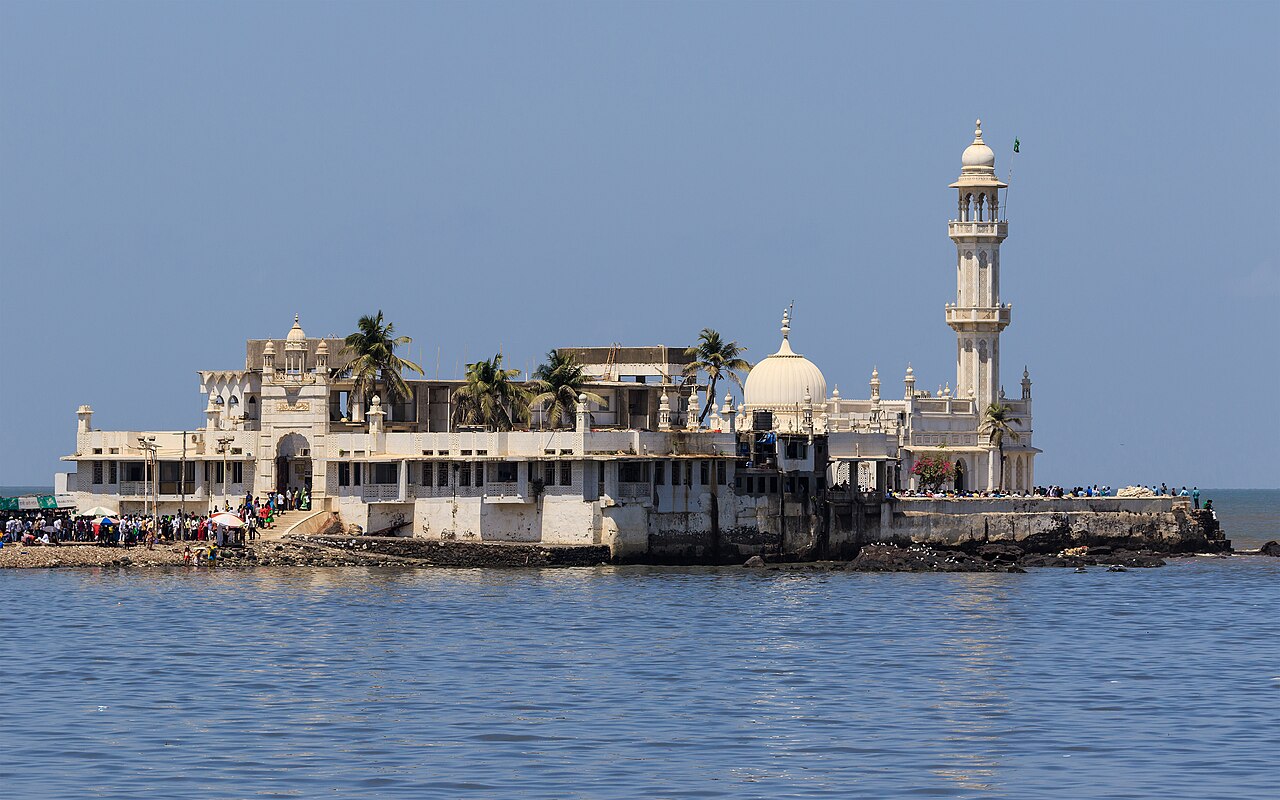
The Haji Ali Dargah stands on a small islet off the Worli and Mahalaxmi coast in Mumbai, reached by a narrow causeway of roughly half a kilometre that runs out into the Arabian Sea. Its origin is commonly dated to around the 15th century, and it has been rebuilt, extended, and repaired many times since, so little of the earliest fabric survives in its present form. Today the shrine and its causeway are maintained by the Haji Ali Dargah Trust, which oversees upkeep, security, and the flow of visitors.
Approaching along the causeway, a visitor passes rows of stalls selling flowers, offerings, and food before reaching the entrance gates. Inside is an open courtyard laid with marble, from which the main structures rise in the region's Indo-Islamic shrine style: a white-painted mausoleum topped by a prominent dome, and an adjoining mosque. The tomb chamber holds the mazar, draped in an ornamented cloth, and the interior carries decorative marble work, mirrored detailing, and inscriptions typical of such shrines. A major restoration completed in the 2010s renewed much of the marble and structural work, which had been worn by decades of salt air and sea spray. Minaret-like towers and the white domes are the features most recognisable from a distance.
The setting is a large part of the shrine's fame. With the sea on both sides of the causeway and the Mumbai skyline rising behind, it is one of the city's most photographed landmarks. Nearby along the coast are the Mahalaxmi temple and the Worli seafront, making the area a well-known stretch for both worshippers and sightseers.
Urs Kab Aur Kaise Manaya Jaata Hai
The Haji Ali urs is observed on 16 Rabi al-Thani in the Islamic calendar, the anniversary marked in memory of the saint. Because the Hijri calendar is lunar and about eleven days shorter than the Gregorian year, the matching English-calendar date shifts about 11 days earlier each year, so the everyday date is different every year. The live date and countdown for this year are shown above.
Around the urs, the dargah holds a set of observances that devotees and visitors take part in over the commemoration:
- A parcham (ceremonial flag) is raised to mark the start of the occasion.
- A ghusl (ceremonial cleaning) of the mazar is carried out.
- Devotees perform chadar-poshi, offering a decorated cloth and flowers at the tomb.
- Milad, recitations, and qawwali singing are held, often late into the evening.
- Langar (community food) is prepared and distributed to those who come.
- The commemoration is rounded off with a Qul gathering of prayers on the closing day.
People come for ziyarat throughout, and crowds are noticeably larger than on ordinary days, drawing visitors from across the city and beyond. Because the islet is tidal, the timing of visits during the urs still has to work around the day's high and low tide, and the trust and volunteers manage the heavier footfall on the causeway.
Kaise Pahunche
The dargah lies off the Worli and Mahalaxmi coast in central Mumbai, so it is easy to reach from most parts of the city. The nearest railway station is Mahalaxmi on the Western Line, a short taxi or auto ride of roughly 2 km from the causeway; Mumbai Central is another convenient option a little further out. Mumbai's BEST buses serve the main Lala Lajpat Rai Marg nearby, and taxis, autos, and app-based cabs are readily available along the coast road.
For those arriving from outside the city, Chhatrapati Shivaji Maharaj International Airport is around 20 km away, roughly 45 minutes to well over an hour by road depending on traffic. From the mainland, vehicles stop near the shrine's entrance and the final stretch is a walk out along the causeway to the islet; there is no vehicle access onto the causeway itself.
That walk is possible only at low tide. At high tide the causeway goes under water and the islet is cut off, so check the day's tide timing before you set out and be prepared to wait if the tide is in. Tide timings shift each day, so a visit that works one morning may not work at the same hour a few days later.
Ziyarat Ke Liye Tips
The single most important thing to plan around here is the tide. The causeway floods at high tide, so check the day's high- and low-tide timing before setting out and aim your visit for low tide, when the path is walkable. Going early in the day helps you avoid both the strongest sun and the biggest crowds, and this matters even more during the urs, when numbers swell and the causeway can get very busy.
Dress modestly, and women may wish to carry a scarf for the head. The stone path can be slippery near the water, so wear sensible footwear and watch your step; you will also need to remove shoes before entering the shrine, so easy-to-remove footwear is practical. Keep your valuables close and secure on the crowded causeway, carry only what you need, and note that facilities and shade along the open stretch are limited, so water and sun cover help in the warmer months.
Conduct yourself quietly and respectfully within the shrine, as you would at any place of worship, and follow any directions given by the trust's staff and volunteers. The dargah is open to visitors of all backgrounds and faiths, which is a large part of its character. For other dargah dates through the year, see the urs calendar.